By Jim | Lead Journalist, The Maine Mirror
A March 27, 2026, public hearing before Maine’s Government Oversight Committee (GOC) was expected to focus on a specific issue: the timeliness of child care payments within the Office of Child and Family Services (OCFS), as outlined in a recent OPEGA report.
However, the proceedings revealed broader concerns—extending beyond policy into questions of transparency, accountability, and how public testimony is received within oversight settings.
A Hearing That Expanded Beyond Its Scope
At the center of the hearing were two public testimonies:
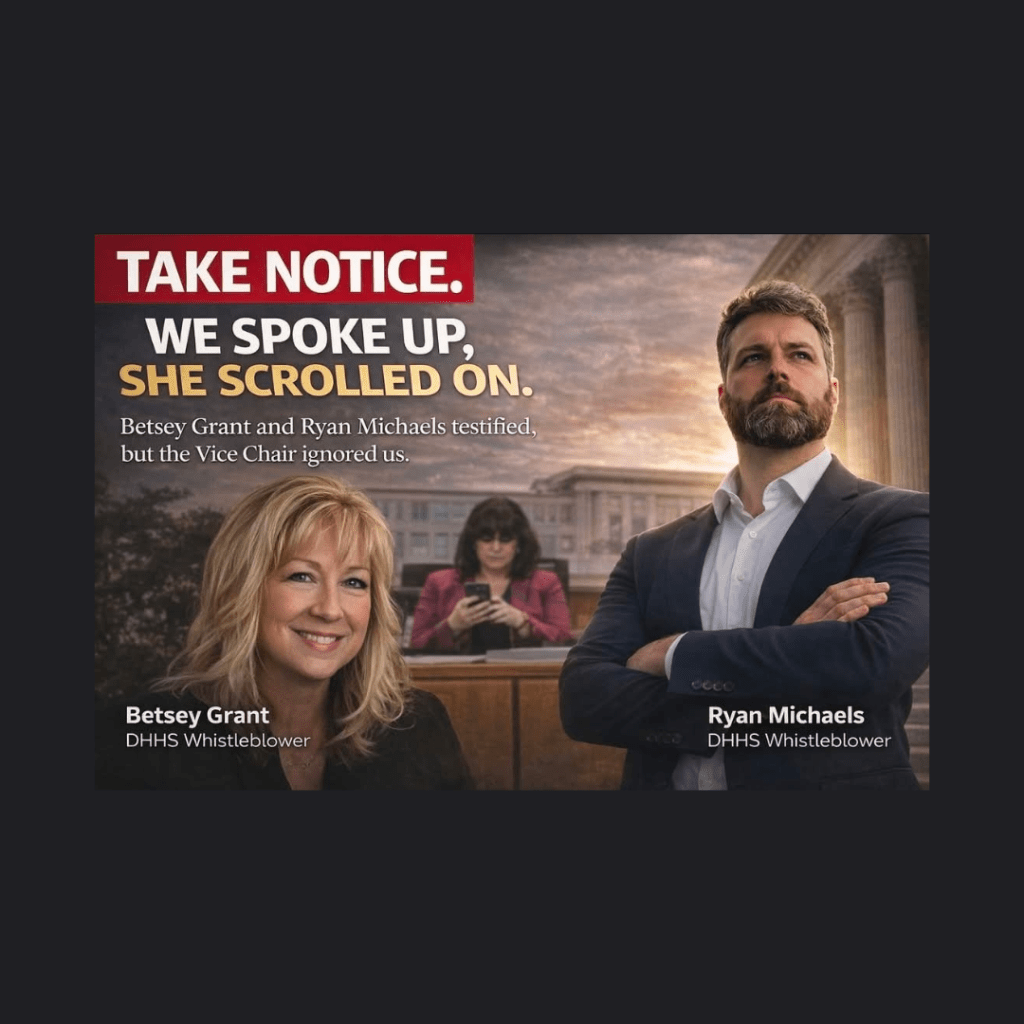
* DHHS whistleblower Betsey Grant
* Public witness Ryan Michaels
Both testimonies introduced concerns that extended beyond the report itself, touching on systemic challenges and barriers within Maine’s child welfare and oversight structures.
Equally notable was not only the substance of the testimony—but the response from committee leadership.
A Moment That Shifted the Tone
The final moments of Betsey Grant’s testimony marked a turning point in the hearing.
After presenting concerns rooted in her experience as a whistleblower, Grant attempted to respond to a comment made by a committee member. She was immediately stopped by Vice Chair Anne-Marie Mastraccio:
“Nope.”
When Grant attempted again to clarify, she was told:
“I am not asking you a question. I do not expect a response from you.”
Mastraccio further stated that statements made during public hearings “do not make [them] true,” characterizing the testimony as opinion rather than verified fact.
The exchange prompted visible tension. Senator Jeff Timberlake directly questioned the implication:
“Are you saying that she’s lying?”
Mastraccio did not affirm that characterization but reiterated that she could not determine truth without hearing “both sides.”
The moment raised broader questions about tone, process, and how whistleblower testimony is interpreted in real time.
The Reality of Whistleblower Testimony
Public testimony is a formal process.
For whistleblowers, it can also be a high-risk one.
Individuals in these positions may face:
* Professional consequences
* Personal strain
* Ongoing uncertainty following public disclosure
In many cases, they are tasked with articulating complex experiences within strict time limits and procedural constraints—often without the ability to fully respond or clarify in the moment.
This dynamic raises an important question:
To what extent do current oversight processes account for the realities faced by those who come forward?
Observations of Conduct and Engagement
Additional observations during the hearing have also prompted public discussion.
Photographs from the session show Vice Chair Mastraccio looking down at her phone during portions of testimony. Attendees noted that this appeared to occur more than once.
While it is understood that legislators manage multiple responsibilities simultaneously, the optics of disengagement—particularly during whistleblower testimony—have raised questions about attentiveness and consistency.
These observations lead to broader considerations:
* Are all testimonies receiving equal attention?
* How does visible engagement affect public confidence?
* What standards should apply during oversight proceedings?
These are questions of perception—but perception plays a critical role in public trust.
Systemic Barriers Raised in Additional Testimony
Following Grant, testimony from Ryan Michaels shifted the discussion toward structural barriers within oversight processes.
The testimony outlined a recurring challenge:
* Citizens are advised that investigations require legislative sponsorship
* Repeated outreach to legislators does not consistently result in engagement
* At the same time, systemic concerns are acknowledged publicly
This creates a disconnect between:
* The process required for accountability
* And the accessibility of that process in practice
Documentation referenced during testimony included:
* A formal legislative sponsorship request (July 28, 2025)
* Freedom of Access (FOA) requests and responses
* Recorded interactions with DHHS and law enforcement
The concerns presented were not framed as conclusions, but as patterns warranting further examination.
Scope and Its Limitations
Throughout the hearing, committee members emphasized remaining within the scope of the OPEGA report.
While this aligns with procedural expectations, it created a visible tension.
Testifiers attempted to connect lived experiences to the broader implications of the report.
The committee redirected discussion toward narrower boundaries.
This raises a broader policy question:
When systemic issues emerge during testimony, should they be constrained—or examined more fully?
Engagement Within the Committee
Despite moments of tension, several committee members demonstrated active engagement:
* Senator Jeff Timberlake asked direct follow-up questions
* Senator Stacey Guerin acknowledged testimony and sought procedural clarity
* Representative Holly Stover requested clarification on financial and enforcement aspects
* Senator Brad Farrin revisited prior FOA-related concerns
These exchanges reflected the intended function of oversight:
* Inquiry
* Clarification
* Continuity across issues
A Moment of Concern Raised—and Cut Short
In the final moments of testimony, a concern was raised regarding conduct during the hearing, including references to earlier exchanges and observed engagement.
Due to time constraints, the statement was cut short and the discussion redirected.
While brief, the moment added to the overall context of how the hearing was experienced by participants.
Questions for Advocate Betsey Grant
In the interest of transparency and continued dialogue, The Maine Mirror is inviting perspective from **Betsey Grant**, whose testimony and advocacy work intersect directly with the issues raised.
The following questions are offered in good faith:
* From your experience, what pressures do whistleblowers face when deciding whether to come forward publicly?
* How do time limits and procedural constraints impact the ability to fully articulate complex concerns?
* Have you encountered situations where individuals chose not to participate due to fear of retaliation or dismissal?
* What role should oversight bodies play in ensuring whistleblower testimony is not only heard—but meaningfully considered?
* What improvements, if any, would better support balanced and effective oversight?
These questions are intended to foster understanding—not confrontation—and to provide space for additional perspective.
What This Hearing Revealed
The March 27 hearing extended beyond its initial purpose and highlighted several key themes:
1. Credibility and Interpretation
Whistleblower testimony was acknowledged, but also qualified—raising questions about how lived experience is evaluated.
2. The Pressure to Participate
Public testimony may carry perceived risks that influence whether and how individuals come forward.
3. Engagement and Perception
Legislative conduct—both verbal and nonverbal—plays a role in shaping public trust.
4. Accessibility of Accountability
Processes that rely on participation must also consider barriers to that participation.
Why It Matters
The Government Oversight Committee serves a critical role in ensuring accountability within systems that directly affect Maine families.
That role depends not only on process—but on:
* Accessibility
* Responsiveness
* Public confidence
When questions arise in any of these areas, they warrant careful consideration.
Final Reflection
The March 27 hearing did not resolve the concerns raised.
But it clarified the environment in which those concerns are being presented.
Oversight is not only defined by the questions asked—
but by how answers are received.
The Maine Mirror will continue to follow this issue and welcomes responses from those involved.
– The Maine Mirror
Reflecting Truth Without Biaa
 The Maine Mirror
Leave a comment