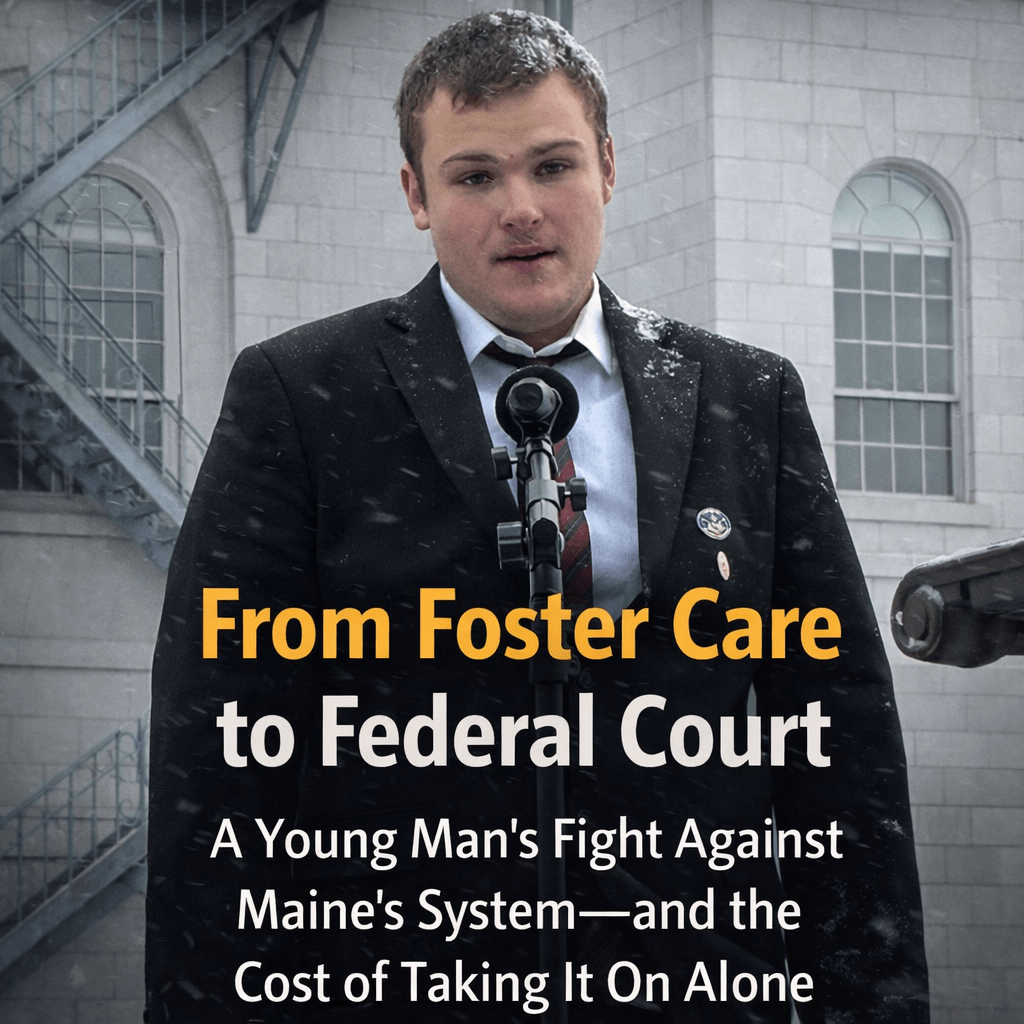
By Ryan Michaels, Journalist | The Maine Mirror
For years, Jacob Keith says his life was shaped by systems that were supposed to protect him.
Instead, he describes a path through foster care, adoption, crisis placements, and institutional settings that left him feeling unheard, uninvestigated, and ultimately alone in trying to make sense of what happened.
Now, he’s taking that fight into federal court—representing himself.
A Life Inside the System
From the beginning, Jacob’s life was intertwined with Maine’s child welfare system.
He was removed from his biological parents due to substance abuse concerns and placed into foster care. During that time, he recalls being prescribed medication early on—something he says eventually stopped around the time of his adoption.
At the start of his adoption, Jacob says he had little to no formal diagnoses.
But over time, things began to change.
“That’s When Everything Shifted”
Jacob points to the years around 2012–2013 as a turning point.
That’s when he says he was first placed into segregation and began experiencing what he describes as unnecessary institutionalization.
According to him, this period marked the beginning of years spent moving through hospitals, crisis homes, and residential facilities.
He attributes these placements, in part, to actions taken by his adoptive guardian, who he believes understood how to navigate—and manipulate—the system.
“These systems didn’t investigate,” Jacob explains. “They moved me.”
A Pattern Without Resolution
Over time, Jacob says the placements continued, but meaningful investigation did not.
One moment that stands out most clearly to him was a Child Protective Services (CPS) investigation that was eventually launched—but, in his view, failed.
He describes it as the first clear example of what he sees as a broader pattern of inaction and systemic breakdown.
“No formal investigation happened until years later,” he says. “And even then, it failed.”
He believes that failure reflects a larger issue within the system itself.
The Cost of Carrying It Alone
Today, Jacob is navigating the legal system without formal representation.
He filed his case in federal court pro se, meaning he is representing himself, while also requesting court-appointed counsel due to what he describes as exceptional circumstances.
Financially, the burden has been significant.
He says he receives no benefits despite being considered disabled by the state. At the same time, he works to cover basic necessities—but says it’s not enough to build stability.
“I can barely even save money,” he explains.
He describes the experience of taking this on alone as overwhelming.
“It has felt horrible to take this on myself,” Jacob says.
Allegations and Legal Arguments
In his filings, Jacob raises a number of serious concerns, including:
- Alleged violations related to disability rights
- Claims of prolonged and unnecessary institutionalization
- Concerns about lack of oversight and investigative failure
- Allegations of misconduct and non-cooperation at the state level
He also references federal legal doctrines and constitutional arguments, which he has studied independently in order to build his case.
While many of these claims have not yet been adjudicated, he believes the evidence he has gathered will be difficult to ignore.
“I’m not a lawyer,” he says, “but I’ve done enormous amounts of research so I can stand my ground.”
More Than What Happened to Him
Outside of the legal battle, Jacob describes himself as living a simple life.
He enjoys fishing, reading, and studying. Those who have worked with him, he says, have described him as highly intelligent—something he has tried to build on through independent learning, particularly in law.
He values independence, something he says developed out of necessity.
“I’m used to doing things myself,” Jacob explains, citing years of limited support from both individuals and institutions.
He also found a sense of belonging in Freemasonry, which he describes as something the child welfare system never provided.
“It’s a family-like system,” he says. “A brotherhood.”
That sense of connection stands in contrast to the instability he experienced growing up.
Separating Who He Is From What He Experienced
Jacob acknowledges that during his time in placements and his adoptive home, there were behavioral challenges.
But he views those behaviors as a response to the conditions he was in—not a reflection of who he is today.
“That wasn’t me,” he says. “That was the version created by the abuse, segregation, and drugs.”
Today, he says he is no longer in those environments, no longer on medication, and no longer experiencing those behaviors.
To him, that change is evidence that the issues were situational—not inherent.
Looking Ahead
Despite the ongoing legal battle, Jacob is thinking about the future.
He has considered returning to school, potentially to study law—a field he has already spent significant time learning on his own.
He enjoys activities like target shooting, hunting, and video games, and continues to look for ways to build a life beyond the circumstances he endured.
“I hope that if I win my case,” he says, “I may be able to seek out something more and bring meaning to my life.”
Still Waiting to Be Heard
His case is ongoing.
What happens next will ultimately be decided in court.
But Jacob’s story raises broader questions—about oversight, accountability, and what happens when someone feels the systems around them have failed.
For now, he continues forward the only way he knows how:
On his own, with what he believes is the truth, and the determination to make it heard.
 The Maine Mirror
Leave a comment