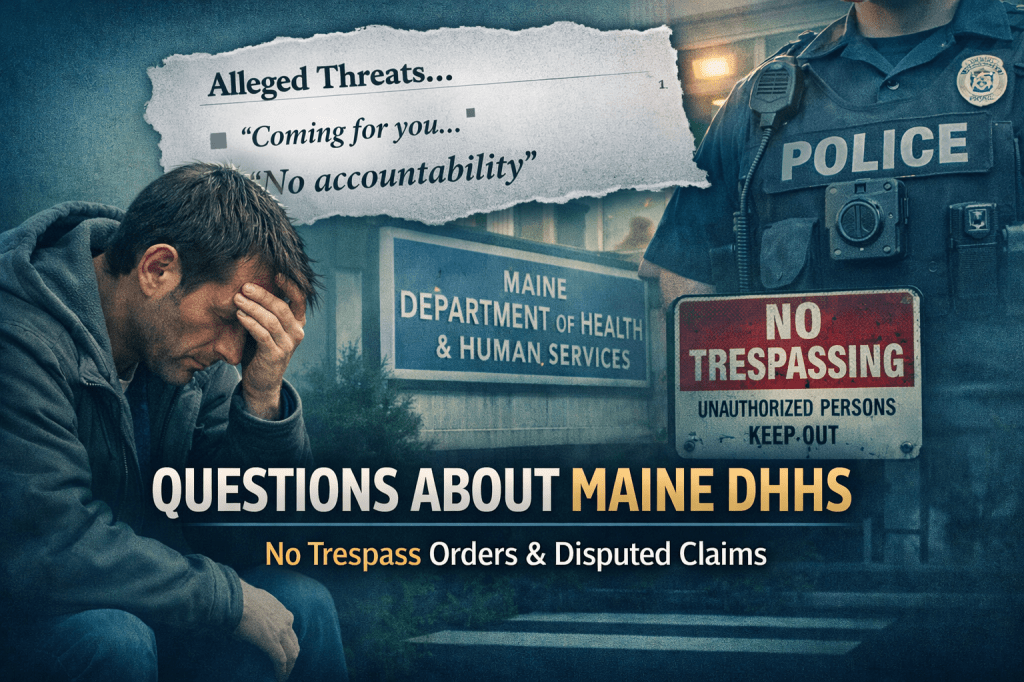

By Jim, Lead Journalist | Maine Mirror
There are stories that feel isolated—deeply personal, emotionally charged, and easy to dismiss as one person’s experience.
And then there are stories that raise a more difficult question:
What happens when the official justification for government action doesn’t align with the full record?
In southern Maine, one father’s case is beginning to draw that distinction.
A Pattern Across Offices
Ryan Michaels, a father navigating an ongoing child welfare case, was issued two no-trespass orders from Maine Department of Health and Human Services (DHHS) offices within a matter of months.
* December 3, 2024 — Sanford DHHS
* March 11, 2025 — Biddeford DHHS
Two different locations.
Two separate actions.
Yet both decisions appear to be connected by similar reasoning—and a lack of clear, timely explanation.
The Explanation Provided
In a written communication following the March 11 incident, DHHS official Amy Cilley stated that the no-trespass decisions were based, in part, on what were described as “threats” made by Michaels on social media.
Those same alleged threats were reportedly tied to the earlier Sanford no-trespass order and factored into the later decision in Biddeford.
At face value, this provides a justification.
But the details behind that justification raise important questions.
Context That May Have Been Omitted
The social media post referenced by DHHS included language stating that Michaels intended to hold individuals and organizations accountable “lawfully, civilly, and peacefully.”
According to Michaels, those qualifying statements were not included when the post was later cited or documented by DHHS.
If accurate, the omission changes the meaning of the statement significantly.
Was the full context of the post considered when determining it constituted a threat?
The full, unedited version of the post includes explicit language emphasizing lawful and non-violent intent.
What Law Enforcement Found
Further complicating the narrative is information obtained through a Freedom of Access Act (FOAA) request, including police body camera footage from the March 11, 2025 incident.
In that footage:
* A DHHS official is heard describing Michaels as “out of touch with reality” when speaking to law enforcement
* Law enforcement officers did not pursue charges
* The behavior described did not meet a criminal threshold
This introduces a second critical question:
If the conduct did not warrant police action, what standard was used to justify barring access to a public agency?
Barriers to Communication
Following the issuance of the no-trespass orders, Michaels reports repeated attempts to obtain clarification:
* Phone calls routed to voicemail
* Emails left unanswered
* In-person attempts met with removal from the building
* Statements from DHHS personnel indicating they would not engage further
At one point, Michaels was told directly that DHHS would “never” speak with him regarding the matter.
No formal explanation process appears to have been provided beyond the written justification.
A Question of Process and Power
No-trespass orders issued by public agencies carry significant implications.
They can:
* Restrict access to publicly funded services
* Limit a parent’s ability to advocate for their children
* Function as a barrier to due process when not clearly justified
In this case, the concern is not simply that the orders were issued—
It’s that:
* The justification may rely on partial or selectively presented information
* Subjective characterizations may have influenced decision-making
* And meaningful opportunities for clarification were effectively closed off
Beyond One Father’s Case
This story is not solely about one individual’s experience.
It raises broader questions about oversight and accountability:
* How are social media statements evaluated by state agencies?
* What standards determine when speech becomes a “threat”?
* What safeguards exist to ensure context is preserved?
* And what recourse does a citizen have when access to a public agency is denied without clear, transparent reasoning?
The Question That Remains
At the center of this case is a question that has yet to be fully answered:
Were the no-trespass orders issued based on a complete and accurate representation of the facts—or on an interpretation shaped by omission and assumption?
Until that question is addressed transparently, the issue remains unresolved.
Not just for Ryan Michaels—
But for anyone who depends on the integrity of the systems meant to serve them.
 The Maine Mirror
Leave a comment